



Table Of Contents:-
- Introduction
- What Is Schema Markup?
- Why Schema Markup Matters For AI Search
- Organisation Schema
- Local Business Schema
- Article Schema
- FAQ Schema
- Person Schema
- Service Schema
- Review Schema
- Product Schema
- Breadcrumb Schema
- WebPage Schema
- How Schema Supports E-E-A-T Signals
- Common Schema Mistakes To Avoid
- How To Test Schema Markup
- Does Schema Guarantee AI Search Visibility?
- The Best Schema Strategy For AI Search
- Conclusion
Search is changing quickly. Traditional search engines still matter, but AI-powered search tools are becoming an important way people find information online. Platforms such as ChatGPT, Google AI Overviews, Gemini, Perplexity, and other AI assistants are changing how users discover businesses, services, and answers.
Instead of showing a list of websites, these tools often generate direct responses by gathering information from multiple sources. This means businesses need to think beyond traditional SEO and understand how AI systems interpret website content.
One of the most useful ways to help AI understand your website is through schema markup.
Schema markup has been part of SEO for many years, but its importance is growing as AI-powered search becomes more common. While schema markup does not guarantee that your website will appear in AI-generated answers, it helps search engines and AI systems understand your content more clearly.
In this guide, we will explore what schema markup is, which schema types can help websites appear in AI search results, and how businesses can implement schema effectively.
What Is Schema Markup?
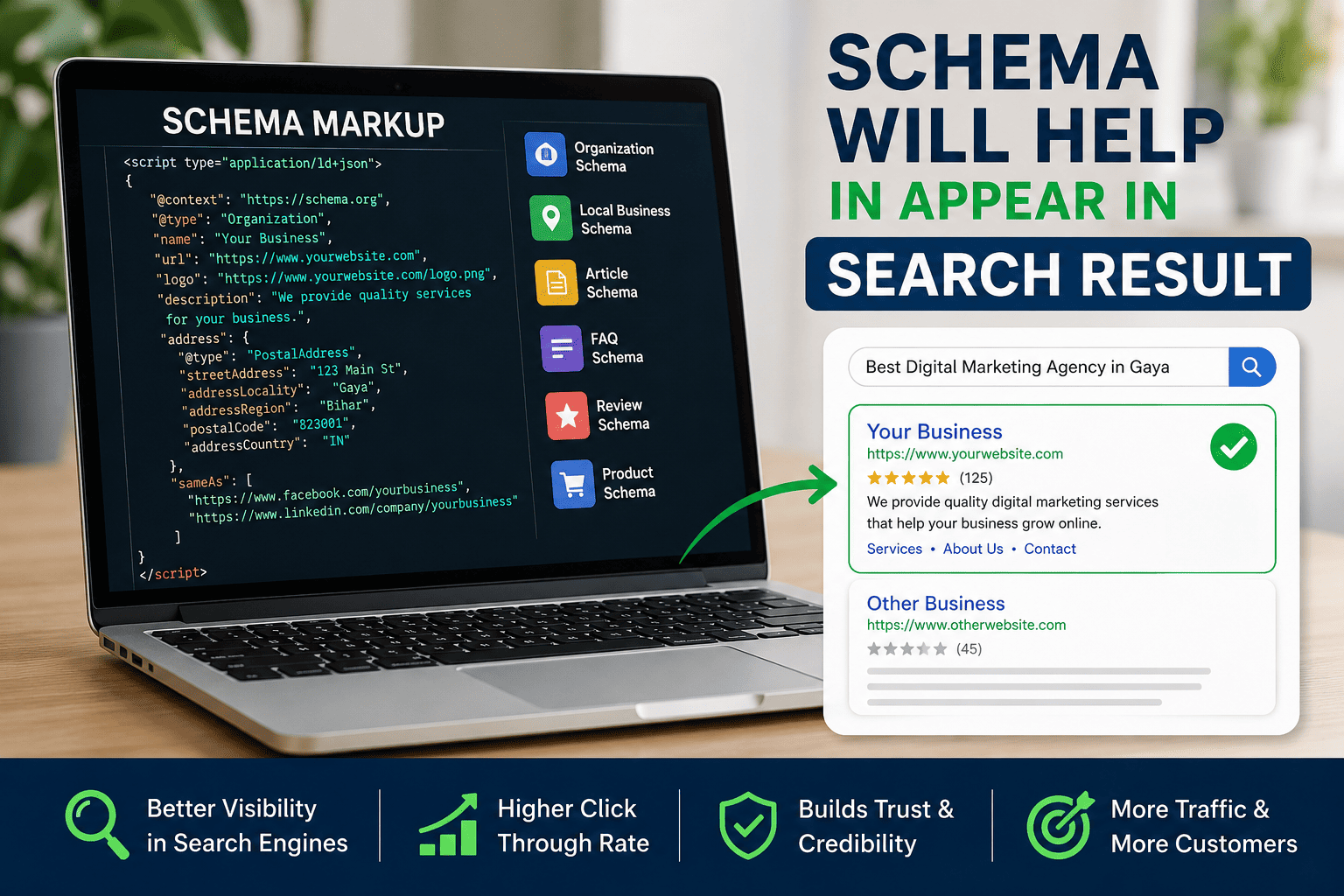
Schema markup is structured data added to a website’s code that helps search engines understand the meaning of content.
Think of schema as a translator between your website and search engines.
For example, a page might contain information about a business, a service, an article, or a product. Humans can usually understand this information easily, but search engines and AI systems benefit from additional context.
Schema markup provides that context.
It tells search engines things such as:
- This page is about a business.
- This content is an article.
- This page contains frequently asked questions.
- This person is the author.
- This business serves a particular location.
- This product has a specific price.
Most schema markup follows standards created by the Schema.org project, which is supported by major search engines.
Why Schema Markup Matters For AI Search
AI search tools are designed to understand information rather than simply index keywords.
When an AI system analyses a webpage, it looks for signals that help it determine:
- What the page is about.
- Who created the content.
- Whether the information is trustworthy.
- How the content relates to user questions.
- Whether the business or organisation is legitimate.
Schema markup provides structured information that supports these evaluations.
While AI systems also analyse page content, backlinks, citations, reviews, and other signals, schema markup helps create a clearer understanding of your website.
This can improve the chances of your content being considered when AI systems generate answers.
Organisation Schema
One of the most important schema types for businesses is Organisation Schema.
This schema helps search engines understand details about your company.
It can include information such as:
- Business name
- Website URL
- Logo
- Social media profiles
- Contact details
- Company description
Organisation Schema helps establish business identity across the web.
For example, if someone searches for digital marketing services in Gaya or elsewhere, AI systems may use multiple sources to understand a company. Organisation Schema provides clear business information directly from your website.
For businesses such as Assurah Marketing Agency, this schema can help reinforce brand identity and improve consistency across search platforms.
Local Business Schema
Local Business Schema is particularly important for companies that want visibility in specific geographic locations.
Even if a company serves clients globally, local visibility can still be valuable.
This schema helps search engines understand:
- Business location
- Opening hours
- Contact information
- Service areas
- Customer reviews
For businesses targeting Gaya and surrounding areas, Local Business Schema provides important location signals.
When users ask AI assistants questions such as:
- “Best digital marketing agency in Gaya”
- “SEO company near me”
- “Website marketing services in Bihar”
AI systems may rely on structured business information to understand local relevance.
Article Schema
Many websites publish blog content to attract visitors through search.
Article Schema helps search engines identify content as an article and understand key information such as:
- Headline
- Author
- Publication date
- Featured image
- Publisher
This schema is particularly useful for businesses creating educational content.
AI systems often reference informative articles when generating answers.
A well-written article combined with proper Article Schema gives search engines additional context about the content.
If your business publishes useful guides, tutorials, and industry insights, Article Schema should be a standard part of your SEO strategy.
FAQ Schema
FAQ Schema is one of the most practical schema types for AI search.
It allows website owners to structure commonly asked questions and answers.
For example:
- What is SEO?
- How does local SEO work?
- What is AI search optimisation?
- How long does SEO take?
AI systems are designed to answer questions directly.
When your content includes structured questions and answers, it becomes easier for search engines and AI models to understand the information.
FAQ sections also help address user concerns naturally while improving content depth.
However, the FAQs should be genuine and useful rather than created solely for SEO purposes.
Person Schema
Trust is becoming increasingly important in search.
AI systems often evaluate who created content before deciding whether to use it as a source.
Person Schema helps identify:
- Authors
- Industry experts
- Business founders
- Contributors
This schema can include information about:
- Name
- Job title
- Professional background
- Social profiles
- Employer
When educational content is linked to identifiable experts, it may help strengthen credibility signals.
Businesses that regularly publish content should consider using Person Schema alongside author pages.
Service Schema
Service Schema helps businesses explain the services they provide.
This schema is useful for companies offering:
- SEO services
- Digital marketing
- Web design
- Content marketing
- Social media management
- Consultancy services
Service Schema provides structured details about offerings and helps search engines understand the purpose of service pages.
Instead of simply seeing a webpage, search engines can identify the exact services available.
For agencies such as Assurah Marketing Agency, Service Schema can help clarify offerings for both search engines and AI systems.
Review Schema
Reviews influence online visibility and trust.
Review Schema allows websites to provide structured review information.
This can include:
- Customer ratings
- Testimonials
- Review counts
- Reviewer details
Positive reviews help establish credibility.
AI search tools often look for evidence that a business has real customers and a positive reputation.
While Review Schema alone will not improve rankings, it contributes to a broader trust profile.
It is important to use review markup accurately and follow search engine guidelines.
Product Schema
Businesses selling products online should implement Product Schema.
This schema helps search engines understand:
- Product names
- Descriptions
- Prices
- Availability
- Ratings
- Brand information
AI shopping assistants and search tools increasingly rely on structured product data.
Accurate Product Schema can improve how products appear across search experiences and AI-generated recommendations.
Breadcrumb Schema
Breadcrumb Schema may seem simple, but it plays an important role in helping search engines understand website structure.
A breadcrumb trail shows users where a page sits within a website.
For example:
Home > Services > SEO Services > Local SEO
This structured hierarchy helps search engines understand relationships between pages.
A well-organised website is easier for both users and AI systems to navigate.
WebPage Schema
WebPage Schema provides additional information about individual pages.
It helps search engines understand:
- Page type
- Main topic
- Relationships between pages
Different webpage types can be identified, including:
- About pages
- Contact pages
- Service pages
- Landing pages
This additional context helps AI systems interpret website content more accurately.
How Schema Supports E-E-A-T Signals
Google often discusses E-E-A-T:
- Experience
- Expertise
- Authoritativeness
- Trustworthiness
Although schema markup does not directly improve E-E-A-T, it helps communicate information that supports these principles.
For example:
- Person Schema identifies authors.
- Organisation Schema identifies businesses.
- Review Schema highlights customer feedback.
- Article Schema provides publication details.
Together, these elements help search engines build confidence in the information presented on your website.
AI systems often rely on similar trust signals when selecting sources.
Common Schema Mistakes To Avoid
Many websites add schema incorrectly.
Some common mistakes include:
Using Incorrect Schema Types
Do not mark every page as an article.
Choose schema that accurately reflects the page content.
Adding False Information
Schema should always match visible page content.
Misleading markup can create trust issues and may violate search engine guidelines.
Ignoring Required Properties
Some schema types require specific fields.
Missing information can reduce effectiveness.
Forgetting To Update Schema
Business information changes over time.
Review schema regularly to ensure accuracy.
Relying Only On Schema
Schema markup supports SEO and AI visibility, but it cannot replace quality content, strong branding, and user experience.
How To Test Schema Markup
After implementing schema, testing is essential.
Useful tools include:
- Google’s Rich Results Test
- Schema Markup Validator
- Search Console reports
These tools can help identify:
- Errors
- Missing properties
- Validation issues
Regular testing ensures structured data remains functional as your website evolves.
Does Schema Guarantee AI Search Visibility?
The simple answer is no.
Schema markup does not guarantee that your website will appear in ChatGPT, Gemini, Perplexity, Google AI Overviews, or any other AI-powered search experience.
AI systems evaluate many factors, including:
- Content quality
- Website authority
- Brand mentions
- User engagement
- Reviews
- Citations
- Technical SEO
- Structured data
Schema markup is one piece of a larger strategy.
However, it is one of the easiest ways to help search engines and AI systems understand your content more clearly.
The Best Schema Strategy For AI Search
Rather than focusing on a single schema type, businesses should use a combination of structured data.
A strong approach often includes:
- Organisation Schema
- Local Business Schema
- Service Schema
- Article Schema
- FAQ Schema
- Person Schema
- Breadcrumb Schema
Together, these create a comprehensive understanding of your website.
AI systems perform best when information is clear, structured, and consistent.
Conclusion
As AI search continues to evolve, businesses need to think beyond traditional keyword optimisation. Search engines and AI assistants increasingly rely on context, credibility, and structured information to understand websites.
Schema markup helps provide that structure. Organisation Schema, Local Business Schema, Article Schema, FAQ Schema, Person Schema, Service Schema, and other structured data types all contribute to a clearer understanding of your content. While schema markup alone will not secure visibility in AI-generated answers, it supports the signals that AI systems use when evaluating websites. For businesses looking to improve their online presence in Gaya while serving clients globally, implementing the right schema markup is a practical step towards stronger search visibility. Combined with useful content, technical SEO, and a consistent brand presence, schema can help make your website easier for both search engines and AI systems to understand.