


Table Of Contents:-
- Introduction
- What Is Conversion Rate Optimization (CRO)?
- Why CRO Matters for Business Growth
- Understanding the Sales Funnel
- How CRO and Sales Funnels Work Together
- Common Reasons Why Visitors Do Not Convert
- Key Elements of a High-Converting Sales Funnel
- CRO Techniques That Improve Conversions
- The Importance of A/B Testing
- Measuring CRO Success
- CRO for Local Businesses in Gaya
- CRO for Service-Based Businesses
- CRO for E-Commerce Businesses
- The Role of Analytics in CRO
- How Professional CRO Services Can Help
- How Assurah Marketing Agency Supports Business Growth
- Conclusion
Getting visitors to a website is only one part of online marketing. The real challenge begins after someone lands on your website. Many businesses invest in search engine optimisation, social media marketing, paid advertising, and content creation to attract traffic, but they often struggle to convert that traffic into enquiries, leads, or sales.
This is where Conversion Rate Optimization (CRO) and sales funnel optimisation become important.
A business can receive thousands of website visitors every month, but if those visitors are not taking action, the marketing investment may not deliver the expected results. Improving conversions helps businesses generate more leads and sales from their existing traffic without necessarily increasing their advertising budget.
Whether you operate a local business in Gaya, run an e-commerce store, provide professional services, or serve customers globally, understanding CRO and sales funnels can help improve business performance.
This guide explains conversion rate optimisation, how sales funnels work, why they matter, and how businesses can improve conversion rates across every stage of the customer journey.
What Is Conversion Rate Optimization (CRO)?
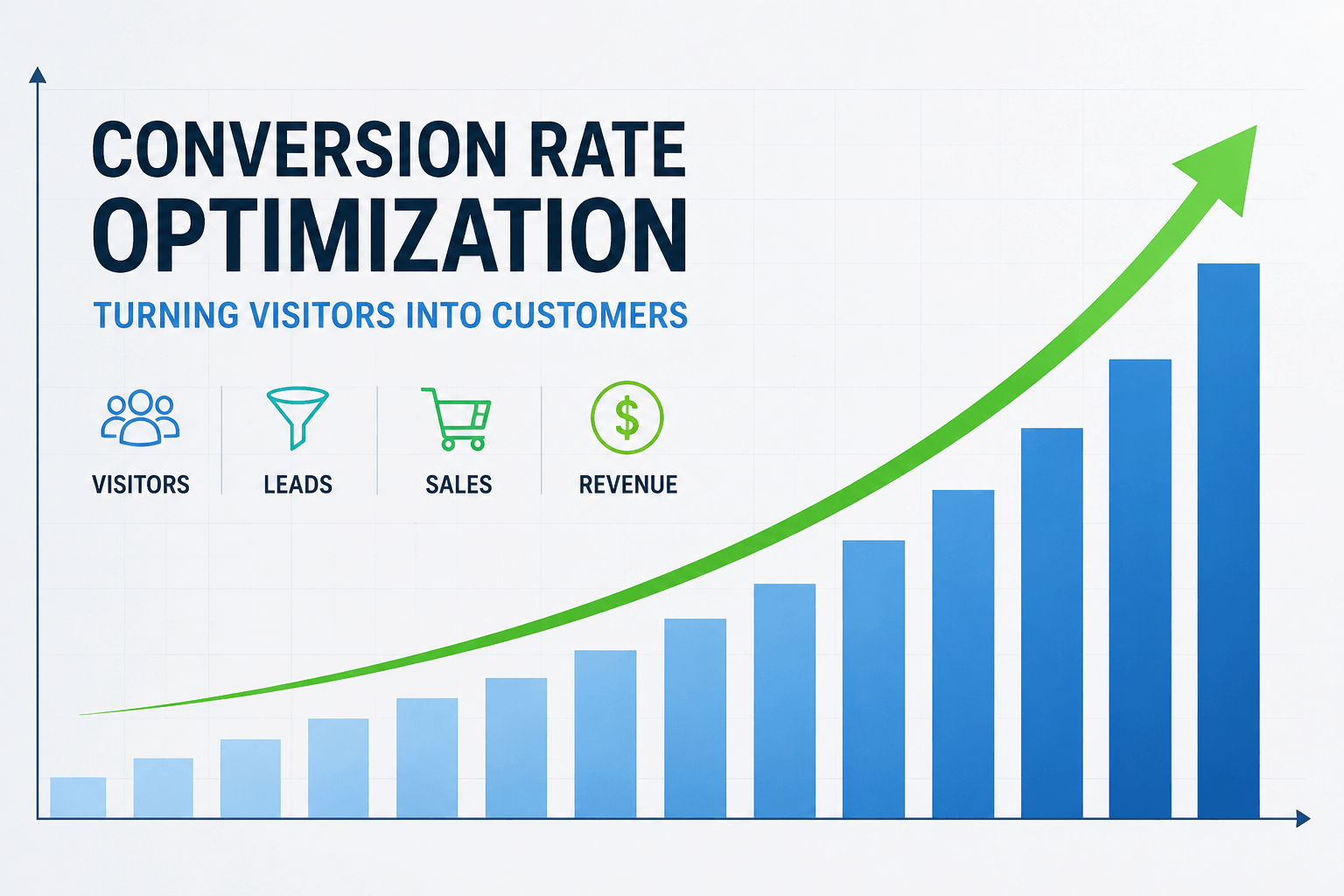
Conversion Rate Optimization is the process of improving a website, landing page, advertisement, or marketing campaign to increase the percentage of visitors who complete a desired action.
A conversion can include:
- Filling out a contact form
- Calling a business
- Booking an appointment
- Requesting a quotation
- Downloading a guide
- Subscribing to a newsletter
- Purchasing a product
- Registering for a webinar
The conversion rate is calculated using a simple formula:
Conversion Rate = (Conversions ÷ Total Visitors) × 100
For example:
- Website visitors: 1,000
- Leads generated: 50
Conversion Rate = 5%
If improvements increase leads to 100 while traffic remains the same, the conversion rate becomes 10%.
This means the business doubles its results without spending additional money to attract more visitors.
Why CRO Matters for Business Growth
Many businesses focus entirely on increasing traffic while ignoring conversion performance.
Although traffic is important, improving conversion rates often produces faster and more cost-effective results.
Benefits of CRO include:
Better Return on Marketing Investment
Every marketing campaign costs money. Whether traffic comes from SEO, Google Ads, social media advertising, or email marketing, CRO helps maximise the value of that traffic.
Lower Customer Acquisition Costs
When more visitors convert into customers, the cost of acquiring each customer decreases.
Increased Revenue
Higher conversion rates typically lead to increased sales and enquiries without requiring additional traffic.
Improved User Experience
Conversion optimisation often improves website usability, navigation, speed, and clarity, creating a better experience for visitors.
More Qualified Leads
Effective optimisation helps attract visitors who are genuinely interested in the products or services being offered.
Understanding the Sales Funnel
A sales funnel represents the journey a potential customer takes before becoming a paying customer.
Not everyone who visits a website is ready to buy immediately. Most people move through several stages before making a decision.
The sales funnel helps businesses understand and guide that journey.
The funnel generally consists of four stages:
Awareness
This is the stage where potential customers first discover a business.
They may find the company through:
- Google search results
- Social media posts
- Online advertisements
- Blog articles
- Referrals
- Video content
At this stage, customers are learning about a problem or exploring possible solutions.
Interest
After discovering a business, visitors begin evaluating whether it can help solve their problem.
They may:
- Read blog posts
- Explore service pages
- Visit product pages
- Watch videos
- Review testimonials
The goal here is building trust and demonstrating expertise.
Decision
At this stage, prospects compare options and consider making a purchase.
They may:
- Request pricing
- Contact the business
- Book consultations
- Compare competitors
- Read reviews
Businesses need clear information and strong trust signals to support decision-making.
Action
This is the conversion stage where the prospect becomes a customer.
Actions may include:
- Making a purchase
- Signing a contract
- Booking a service
- Completing an enquiry form
An effective funnel removes obstacles that might prevent visitors from taking action.
How CRO and Sales Funnels Work Together
Sales funnels guide visitors through the buying journey, while CRO improves each stage of that journey.
Think of the sales funnel as a pathway and CRO as the process of removing barriers along that pathway.
For example:
- CRO improves landing pages to increase enquiries.
- CRO improves forms to increase submissions.
- CRO improves product pages to increase purchases.
- CRO improves checkout processes to reduce abandonment.
When both strategies work together, businesses can achieve stronger marketing results.
Common Reasons Why Visitors Do Not Convert
Many websites lose potential customers because of avoidable issues.
Some of the most common problems include:
Slow Website Speed
Modern users expect websites to load quickly.
Slow websites often experience:
- Higher bounce rates
- Lower engagement
- Reduced conversions
Website speed should be monitored regularly.
Unclear Messaging
Visitors should immediately understand:
- What the business offers
- Who it serves
- Why it is different
- What action they should take
Confusing messaging often causes visitors to leave.
Poor Mobile Experience
A large percentage of internet traffic now comes from mobile devices.
If a website is difficult to use on smartphones, conversion rates may suffer.
Weak Calls to Action
Calls to action guide users towards the next step.
Examples include:
- Contact Us
- Get a Quote
- Book a Consultation
- Request Pricing
Calls to action should be visible and easy to understand.
Lack of Trust Signals
Visitors often need reassurance before making a decision.
Trust signals may include:
- Customer reviews
- Testimonials
- Case studies
- Industry certifications
- Awards
- Client logos
These elements help reduce uncertainty.
Key Elements of a High-Converting Sales Funnel
Successful sales funnels share several common characteristics.
Clear Customer Journey
Visitors should know exactly what to do next.
Every page should guide users towards a specific action.
Relevant Content
Content should address the visitor’s questions and concerns at each stage of the funnel.
Examples include:
- Educational blog posts
- Service guides
- Product comparisons
- Frequently asked questions
- Case studies
Strong Landing Pages
Landing pages should focus on a single objective.
Effective landing pages typically include:
- Clear headlines
- Relevant benefits
- Customer proof
- Strong calls to action
Lead Capture Opportunities
Businesses should provide opportunities to collect contact information.
Methods may include:
- Contact forms
- Newsletter subscriptions
- Free consultations
- Downloadable resources
Follow-Up Systems
Many prospects do not convert during their first visit.
Follow-up systems such as email marketing and remarketing campaigns help maintain engagement.
CRO Techniques That Improve Conversions
There is no single formula for increasing conversion rates.
However, several proven techniques consistently help businesses improve performance.
Improve Website Navigation
Visitors should be able to find information quickly.
Simple navigation structures often perform better than complicated menus.
Simplify Forms
Long forms can reduce conversions.
Ask only for essential information.
Shorter forms often generate more enquiries.
Optimise Calls to Action
Calls to action should:
- Stand out visually
- Use clear language
- Appear throughout the page
- Match user intent
Use Customer Testimonials
Real customer experiences build confidence.
Testimonials can help visitors feel more comfortable contacting a business.
Improve Page Speed
Faster websites typically provide better user experiences and higher conversion rates.
Add Live Chat Options
Live chat can help answer questions immediately, reducing hesitation and improving conversion opportunities.
The Importance of A/B Testing
It involves comparing two versions of a webpage or element to determine which performs better.
Businesses can test:
- Headlines
- Images
- Buttons
- Forms
- Calls to action
- Landing page layouts
For example:
Version A may use a “Get a Free Consultation” button.
Version B may use a “Speak With Our Team Today” button.
Testing reveals which version generates more conversions.
Small changes can sometimes produce meaningful improvements.
Measuring CRO Success
Conversion optimisation should always be based on data rather than assumptions.
Important metrics include:
Conversion Rate
Measures the percentage of visitors completing a desired action.
Bounce Rate
Shows how many visitors leave without interacting.
Average Session Duration
Indicates how long users stay on a website.
Lead Generation Numbers
Tracks the quantity of enquiries generated.
Cost Per Acquisition
Measures how much it costs to acquire a customer.
Revenue Per Visitor
Shows how much revenue is generated from website traffic.
Monitoring these metrics helps businesses identify improvement opportunities.
CRO for Local Businesses in Gaya
Local businesses often focus heavily on attracting traffic from nearby customers.
For businesses in Gaya, CRO can help maximise local search visibility and enquiry generation.
Effective strategies include:
- Optimising Google Business Profile information
- Displaying local reviews
- Including clear contact information
- Using location-based landing pages
- Improving mobile usability
- Adding click-to-call functionality
Local visitors often want quick access to information and simple ways to contact a business.
CRO for Service-Based Businesses
Service businesses typically rely on enquiries rather than direct purchases.
Their sales funnels often include:
- Website visit
- Service page review
- Contact form submission
- Consultation
- Proposal
- Client conversion
Optimisation should focus on:
- Building trust
- Explaining services clearly
- Showcasing results
- Reducing friction during enquiries
This approach can significantly increase lead generation.
CRO for E-Commerce Businesses
E-commerce businesses face different conversion challenges.
Common optimisation areas include:
- Product descriptions
- Product images
- Pricing presentation
- Checkout process
- Shipping information
- Customer reviews
Reducing checkout friction is particularly important because abandoned carts can lead to lost revenue.
The Role of Analytics in CRO
Analytics tools provide valuable insight into visitor behaviour.
Businesses can learn:
- Which pages perform best
- Where users leave the website
- Which traffic sources convert most effectively
- Which devices generate the highest conversions
These insights support informed decision-making.
Without data, optimisation efforts often become guesswork.
How Professional CRO Services Can Help
Many businesses understand the importance of conversion optimisation but struggle to identify specific issues affecting performance.
Professional CRO specialists analyse:
- User behaviour
- Website performance
- Landing page effectiveness
- Funnel performance
- Conversion bottlenecks
They then implement improvements based on evidence rather than assumptions.
A structured CRO strategy often produces better results than making random website changes.
How Assurah Marketing Agency Supports Business Growth
Conversion optimisation is not just about increasing website enquiries. It is about creating a complete customer journey that helps visitors become customers.
At Assurah Marketing Agency, CRO strategies are integrated with broader digital marketing efforts, including SEO, website design, content marketing, paid advertising, and lead generation.
By understanding customer behaviour and analysing performance data, businesses can identify opportunities to improve every stage of the sales funnel.
Whether serving local businesses in Gaya or organisations operating in international markets, a structured CRO approach can help improve marketing efficiency, increase lead generation, and support long-term growth.
Conclusion
Conversion Rate Optimization and sales funnel management play an important role in modern digital marketing.
Generating website traffic is only the first step. Businesses achieve stronger results when they focus on converting visitors into leads and customers.
By understanding customer behaviour, improving user experiences, testing website elements, and optimising each stage of the sales funnel, organisations can achieve better performance without constantly increasing marketing spend.
Whether you operate a local business in Gaya, provide professional services, or serve customers across multiple countries, investing in CRO can help improve lead generation, increase sales, and strengthen overall business growth.
A well-designed sales funnel combined with ongoing conversion optimisation creates a more effective path from visitor to customer, helping businesses make better use of every marketing opportunity.